
All five picks are genuine RTX graphics cards, so the choice is tier and fit: the GIGABYTE RTX 5080 is the step-up card with a 256-bit bus, the three RTX 5060 Ti cards carry 16GB in shorter bodies, and the ASUS TUF RTX 5060 drops to 8GB for a wider 3.1-slot (product name) cooler. Blackwell architecture and DLSS 4 are stated in the facts for the ASUS Dual pair, the GIGABYTE and the TUF; the PNY listing gives neither.
What separates them is size, memory and clocks: lengths run from 9.0 inches on the Dual pair to 13.46 inches on the GIGABYTE, weights from 1.4 to 4.03 pounds. Two spec tables list a height of 0.1 inches, a figure that cannot describe a dual-fan card; those heights are never used for ranking, so plan around length and slot width.
As an Amazon Associate, we earn from qualifying purchases.



Pick by Your Need
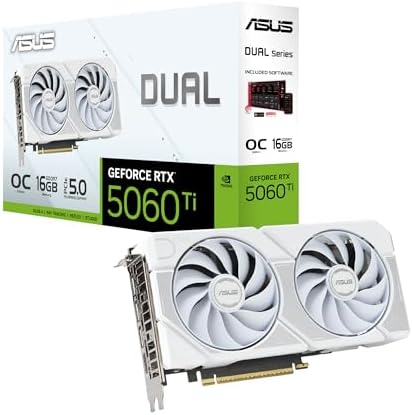
- Best overall: ASUS Dual RTX 5060 Ti 16GB. 16GB in a 9.0-inch, 2.5-slot (product name) body with a stated 2632 MHz OC clock.
- Best for high-end builds: GIGABYTE RTX 5080 Gaming OC. The only stated 256-bit bus here, in a 13.46-inch body.
- Highest named boost clock (product name): PNY RTX 5060 Ti 16GB OC. A 2692 MHz boost (product name) and 448 GB/s of bandwidth.
- Best for white builds: ASUS Dual RTX 5060 Ti White. The black Dual’s 16GB specification in a white finish.
- Best durability pick: ASUS TUF RTX 5060 8GB. A 3.1-slot (product name) cooler and the highest stated AI figure, with half the 5060 Ti memory.
Quick Answer
Choose the GIGABYTE RTX 5080 if your case fits a 13.46-inch card and you want the widest stated memory bus here, 256-bit. Choose any of the three 16GB RTX 5060 Ti cards for a shorter build, and the TUF RTX 5060 only if its 8GB buffer fits your workload.
Comparison Table
| Product | GPU | Memory | Bus width | Boost clock | Length | Buy |
|---|---|---|---|---|---|---|
| ASUS Dual RTX 5060 Ti 16GB | RTX 5060 Ti | 16GB GDDR7 (product name) | not stated | 2632 MHz (OC mode) | 9.0 in | View on Amazon |
| PNY RTX 5060 Ti 16GB OC | RTX 5060 Ti | 16GB GDDR7 | 128-bit (product name) | 2692 MHz (product name) | 9.65 in | View on Amazon |
| GIGABYTE RTX 5080 Gaming OC | RTX 5080 | 16GB GDDR7 | 256-bit | not stated | 13.46 in | View on Amazon |
| ASUS Dual RTX 5060 Ti White | RTX 5060 Ti | 16GB GDDR7 (product name) | not stated | 2632 MHz (OC mode) | 9.0 in | View on Amazon |
| ASUS TUF RTX 5060 8GB | RTX 5060 | 8GB GDDR7 (product name) | not stated | 2677 MHz (OC mode) | 11.9 in | View on Amazon |
Decision Guide
For a small chassis, start with the ASUS Dual pair: at 9.0 inches and 2.5 slots (product name) they are the shortest cards here, both with the full 16GB buffer. Pick by build color, because their stated clocks, memory and dimensions match.
For high-resolution textures or local AI work, the GIGABYTE RTX 5080 is the only card here with a stated 256-bit bus, double PNY’s 128-bit (product name). That width comes with the largest body here, 13.46 inches and 4.03 pounds, so confirm case clearance and GPU support first.
Compare clock figures: PNY names a 2692 MHz boost speed (product name), the ASUS Dual cards state 2632 MHz in OC mode against 2602 MHz default, and the TUF states 2677 MHz in OC mode. The GIGABYTE listing gives no clock figure, so it cannot be ranked on speed.
If your workload fills more than 8GB of video memory, rule the TUF out first: its 8GB is half the 16GB every other card carries, despite the widest stated slot figure here, 3.1 slots (product name).
1. ASUS Dual RTX 5060 Ti 16GB Black — Best overall
This is the balanced pick of the three 5060 Ti cards: 16GB of GDDR7 (product name), a stated 2632 MHz OC clock against 2602 MHz default, and 767 AI TOPS, in the joint-shortest body here at 9.0 inches and 2.5 slots (product name). Its Axial-tech fans use a smaller hub, longer blades and a pressure-raising barrier ring. The trade-off is detail: its listing names HDMI 2.1b and DisplayPort 2.1b (product name), but its memory bus width is missing, where PNY’s name gives 128-bit (product name).
| Spec | From the listing |
|---|---|
| Memory | 16GB |
| OC mode clock | 2632 MHz |
| Default mode clock | 2602 MHz |
| Dimensions | 9.0 x 4.7 x 2.0 inches |
| Weight | 1.45 pounds |
2. PNY RTX 5060 Ti 16GB OC Dual-Fan — Best highest named boost clock (product
The PNY names the highest clock figure here, a 2692 MHz boost speed (product name); the highest facts-stated clock is the TUF’s 2677 MHz. It also gives the only memory bandwidth figure: 448 GB/s across a 128-bit bus (product name) with 16GB of GDDR7. Its dual fans feed a dense heatsink, a vented metal backplate adds passive cooling and sag reinforcement, and VelocityX software handles tuning and fan curves. The trade-off is data quality: its spec table lists a height of 0.1 inches, which cannot describe this dual-fan card, so re-check dimensions on the product page and plan around the 9.65-inch length.
| Spec | From the listing |
|---|---|
| Memory | 16GB GDDR7 |
| Bus width | 128-bit (product name) |
| Boost speed | 2692 MHz (product name) |
| Dimensions | 9.65 x 4.72 inches (spec height reads 0.1 in, implausible) |
| Weight | 1.98 pounds |
3. GIGABYTE RTX 5080 Gaming OC 16G — Best for high-end builds
The GIGABYTE is the only RTX 5080 here and the only card with a 256-bit memory interface, paired with 16GB of GDDR7 and WINDFORCE cooling (product name) on PCIe 5.0. It is the largest card here at 13.46 inches long, 5.59 inches wide and 4.03 pounds, over double any 5060 Ti’s weight. The trade-off is information: its listing gives no clock figure, so its speed cannot be compared with the other four cards’ clock figures.
| Spec | From the listing |
|---|---|
| GPU | GeForce RTX 5080 |
| Memory | 16GB GDDR7 |
| Bus width | 256-bit |
| Boost clock | The listing does not state it |
| Dimensions | 13.46 x 5.59 x 2.76 inches |
| Weight | 4.03 pounds |
4. ASUS Dual RTX 5060 Ti 16GB White — Best for white builds
This is the white edition of the ASUS Dual above, with a matching specification: 16GB of GDDR7 (product name), the same 2632 MHz OC and 2602 MHz default clocks, the same 9.0-inch length and 2.5-slot design, at a lower stated 1.4 pounds. Its facts add that the 2.5-slot design targets compatibility and cooling efficiency in small chassis, with the black card’s Axial-tech fans. The trade-off is its spec table, which lists a height of 0.1 inches against that 2.5-slot design; treat it as a listing error and re-check it on the product page.
| Spec | From the listing |
|---|---|
| GPU | GeForce RTX 5060 Ti |
| Memory | 16GB |
| OC mode clock | 2632 MHz |
| Default mode clock | 2602 MHz |
| Dimensions | 9.0 x 4.7 inches (spec height reads 0.1 in, implausible) |
| Weight | 1.4 pounds |
5. ASUS TUF RTX 5060 8GB OC — Best compact-memory trade-off
The TUF is the only RTX 5060 here and the only card with 8GB of memory, half the other four’s buffer, but it states the highest AI figure at 785 AI TOPS and a 2677 MHz OC clock against 2640 MHz default. Its military-grade components are stated for power delivery and lifespan, and its 3.1-slot (product name) cooler is the widest stated slot figure here, in an 11.9-inch body. Skip it if your workload needs more than 8GB; the trade-off makes sense where the wider cooler and component grade matter more than the buffer.
| Spec | From the listing |
|---|---|
| Memory | 8GB |
| OC mode clock | 2677 MHz |
| Default mode clock | 2640 MHz |
| Dimensions | 11.9 x 5.3 x 2.4 inches |
| Weight | 2.5 pounds |
Shopping Checklist
- Measure case GPU clearance against the stated card lengths: 9.0 to 13.46 inches.
- Count the slots a card occupies: 2.5 (product name) for the Dual pair, 3.1 (product name) for the TUF; the others state no slot count.
- Ignore the 0.1-inch height figures in two spec tables; re-check the real height on the product page.
- Confirm power supply wattage and PCIe connectors on the product page.
- Check the return window on the product page in case the card does not fit.
FAQ
Does memory size or bus width matter more on an RTX card?
Both matter differently: buffer size, 16GB on four cards here and 8GB on the TUF, sets how much texture and project data the card holds, while bus width, 256-bit on the GIGABYTE and 128-bit (product name) on the PNY, sets how fast that data moves. Compare both figures when choosing.
How do I know an RTX card will fit my case?
Compare stated length and slot width with your case’s GPU clearance: the shortest cards here are 9.0 inches and 2.5 slots (product name), the longest 13.46 inches. Treat an implausible figure as a reason to re-check the product page, not a measurement to plan around.
What is the difference between OC mode and default mode clocks?
Some listings state two figures, such as 2632 MHz in OC mode and 2602 MHz default on the ASUS Dual cards. The OC figure is the higher setting the card’s software can apply, while the default figure is the out-of-box speed, so compare cards on the same basis.
Final Verdict
The GIGABYTE RTX 5080 is the clear step up here, with the only stated 256-bit bus and 16GB of GDDR7, if your case fits its 13.46-inch body. For smaller builds, the ASUS Dual and PNY 5060 Ti cards deliver the same 16GB buffer in bodies under 10 inches, with PNY naming the highest boost figure at 2692 MHz (product name). The TUF suits buyers who accept an 8GB buffer for its wider cooler and military-grade components. Whichever card you choose, verify length, slot width and height on the product page: two listings carry a height figure that cannot be right.
Prime covers fast, free delivery on eligible items. See whether a Prime free trial is available for your account.
Check Prime on Amazon →Product and ASIN Reference
| Product | ASIN | Buy |
|---|---|---|
| ASUS Dual RTX 5060 Ti 16GB Black | B0F7WB6LSH | View on Amazon |
| PNY RTX 5060 Ti 16GB OC | B0F4Y6N6PW | View on Amazon |
| GIGABYTE RTX 5080 Gaming OC | B0DS2R6948 | View on Amazon |
| ASUS Dual RTX 5060 Ti 16GB White | B0G1FVLWSG | View on Amazon |
| ASUS TUF RTX 5060 8GB | B0F77GW9RK | View on Amazon |
Types of Graphics Cards
Graphics cards are grouped mainly by chip tier and by manufacturer brand (a given GPU chip is sold by multiple board partners with different coolers and clock speeds). Higher-tier chips generally handle higher resolutions and settings; lower-tier chips suit 1080p or lower settings at a lower price.
Two cards built on the same GPU chip from different board partners can still differ in cooling, noise, and factory clock speed, so the specific card model matters beyond just the chip name alone.
Frequently Asked Questions
Does buying a specific brand's version of a GPU chip matter?
Yes to some degree -- board partners vary cooling design, noise level, and factory clock speed even when using the same underlying GPU chip, so two cards with the same chip name can still perform and sound differently.
What's the practical difference between competing GPU brands at a similar price?
Performance in a given game can favor one brand over another depending on how well that title is optimized for each architecture, so checking reviews for the specific games you play matters more than brand reputation alone.







Write Your Review
No reviews yet. Be the first to share your experience!